Intro to Native Plants
A plant is not a plant is a plant
When choosing plants for your garden, it is important to be aware of the distinction between native and non-native plants. In the US, a plant that has been endemic to the region prior to European settlement is a native plant. Non-native species are plants that were introduced by humans from other regions.
Non-native plants may be
- Non-adapted: Plants that are not adapted to the local climate and soil
- Adapted: Plants that originated elsewhere, but thrive in the local climate and soil
- Invasive: Plants that thrive too well in the local climate and soil, and outcompete native plants
Non-native species include turf grasses like St. Augustine and Bermuda grass.
Native plants can help your yard come alive
Turf grass that is kept mown, raked and weeded is essentially a green food desert, and cannot support wildlife1. What might not be obvious is that the plants that you choose for your garden can make a difference in how much wildlife you can attract and support.
Everyone needs bugs
To help native wildlife, you must start with insects. Beneficial insects have the following key roles to play:
- pollinate plants
- decompose dead plant matter, dung, other insects
- prey on other insects and keep the insect population balanced
Insects are also a food source for many species. A single nest of chickadees requires more than 5000 caterpillars to successfully raise one brood2. So while bird feeders might help adult birds, they don’t feed nestlings.
Bugs need native plants
Insects need at least two kinds of plants to thrive:
- pollinator plants that supply nectar and pollen
- host plants that support insects in the larval stage
It is as host plants that native plants outshine adapted plants in their utility. The vast majority of North American caterpillars can only feed on a small number of specific plants that they have co-evolved with, and a loss of native host plants is leading to declining insect populations2.
In cases where a host plant has different varieties in different regions, the safest choice is to grow the native variety. For example, monarch butterflies famously need milkweed to reproduce. If you are in Texas, you should grow milkweeds that are native to Texas, and not tropical milkweed, because non-native milkweed may be causing monarchs to change their migratory patterns in undesirable ways, and may be increasing the spread of a parasitic disease in the population3.
Bugs and berries bring birds
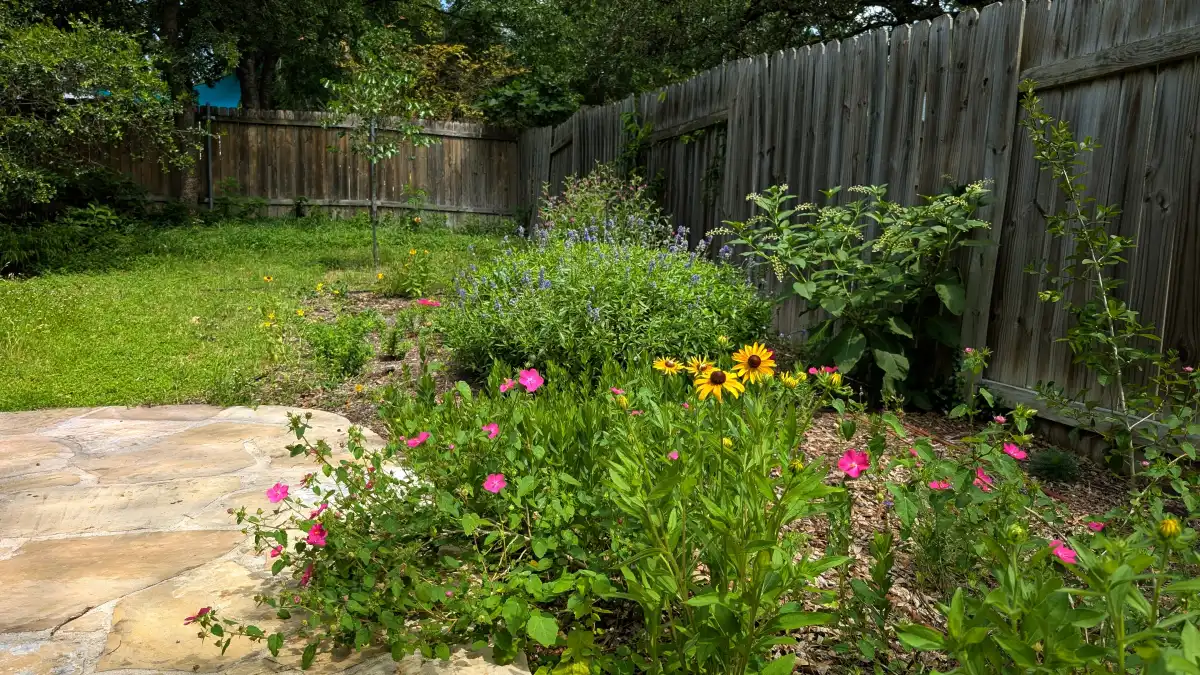
Native plants are the best kind of bird feeder4. Birds seem to prefer native berries for their more nutritious content than non-native berries5. Cardinals, goldfinches, chickadees, wrens, mockingbirds etc flock to the Plant Bat Habitat to eat seeds and berries. Hummingbirds are also constant visitors to sip from these hummingbird magnets.
Native plants can help slash your water bill
The Plant Bat Habitat has about 4500 sq ft of yard space. Turf grass of this size would need over 100,000 gallons a year to stay lush and green throughout the year. By contrast, native plant beds might need up to 10,000 gallons a year. The cost savings on the water bill comes out to $150-$200 a month. See this post for a deep dive.
Native plants are low maintenance
Native plant beds allow you to skip the mowing, blowing, raking, fertilizers, herbicides and pesticides. Once established, they naturally suppress weeds when planted densely, or when groundcovers are used. In general, native plant beds make it easy to leave the land be.
Native plant beds also require less maintenance than stone/gravelscapes.
Replacing turf grass with stone/gravelscapes might be tempting because you don’t have to run any irrigation. This might work in West Texas or New Mexico; but Austin is no desert, and it gets so much rainfall that weeds quickly pop up and can take over a stonescape. Landscape fabric is a scam and does nothing to suppress weeds in the long run. Leaves and other organic matter collect on the rocks and have to be blown away. Stonescapes provide no ecological benefit. They absorb heat and increase local temperatures6. It’s a lot of labor to add a stonescape, and a lot of labor to remove it if you end up changing your mind.
If I sound bitter, it’s because I am - I speak from personal experience. Having said that, I do think stonescapes can look great as accents. They can liven up your garden when used judiciously. Just be prepared for the toil involved in keeping them just so.
Choose native
References
-
https://www.npsot.org/posts/invasives-choose-native-over-tropical-milkweed/ ↩
-
https://www.wildflower.org/magazine/native-plants/skip-bird-feeder ↩
-
https://www.nwf.org/Magazines/National-Wildlife/2021/Feb-Mar/Gardening/Native-Berries ↩
-
https://www.roundrocktexas.gov/water-spot/2022/08/dont-rock-your-landscape/ ↩